
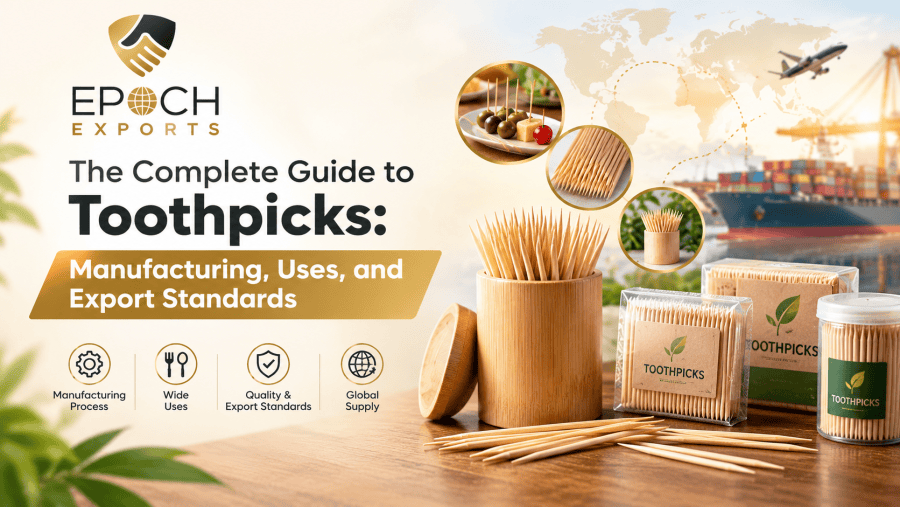
The Complete Guide to Toothpicks: Manufacturing, Uses, and Export Standards
Introduction
Global demand for Toothpicks continues to grow across restaurants, hotels, catering services, retail stores, airlines, and food packaging industries. Despite being a small product, it plays an important role in dining convenience, food presentation, and hospitality operations. Buyers sourcing in bulk often evaluate factors such as material quality, hygiene standards, packaging flexibility, and export compliance before making purchasing decisions.
For importers, distributors, and wholesalers, understanding how Toothpicks are manufactured and supplied can simplify procurement decisions and help identify reliable sourcing partners. Whether purchasing for hospitality businesses, retail distribution, or private-label requirements, understanding production methods, specifications, and export standards helps ensure consistent product quality and customer satisfaction.
Understanding Toothpicks and Their Growing Global Demand
The global food service industry relies heavily on disposable and hygienic dining accessories. Toothpicks have become a standard product in restaurants, cafés, fast-food chains, catering companies, hotels, and households due to their versatility and convenience.
Today, many tooth picks suppliers serve domestic and international markets with:
- Customized packaging
- Bulk supply capabilities
- Private-label solutions.
As consumers increasingly prefer hygienic and eco-friendly products, the demand for biodegradable wooden alternatives continues to rise. Many importers also prefer sourcing from experienced tooth picks exporters that can provide consistent quality, timely deliveries, and compliance with international market requirements.
According to Epoch Exports, wooden toothpick products are widely supplied to hospitality, retail, and export markets worldwide.
How Toothpicks Are Manufactured: Step-by-Step Process?
1. Wood Selection and Preparation
The manufacturing process begins with selecting premium-quality wood. Carefully chosen wood helps ensure strength, smooth finishing, and splinter-free performance.
Reliable tooth picks manufacturers prioritize food-safe raw materials to ensure hygiene and durability throughout the product lifecycle.
2. Cutting and Splint Formation
The wood is processed into thin sheets and further cut into narrow splints. These splints form the base material used for manufacturing toothpicks.
Precision cutting helps maintain uniform dimensions and consistency across large production batches.
3. Shaping and Pointing
The splints are processed through specialized machinery that shapes them into cylindrical or flat profiles. The ends are sharpened according to customer requirements. Manufacturers may produce:
- Single-pointed variants
- Double-pointed variants
- Flat-profile variants
- Long hospitality variants
4. Drying and Polishing
After shaping, the products undergo drying processes to reduce moisture content and improve durability.
Polishing ensures a smooth finish, helping eliminate rough edges while improving user safety and comfort.
5. Quality Inspection
Strict quality checks help verify:
- Surface smoothness
- Dimensional accuracy
- Strength
- Moisture consistency
- Splinter-free finish
- Food-contact suitability
Leading tooth picks manufacturers maintain quality-control procedures to meet domestic and export market expectations.
6. Packaging and Export Preparation
The finished products are packed according to customer specifications. Common packaging formats include:
- Paper boxes
- Dispenser packs
- Bulk cartons
- Retail packs
- Customized private-label packaging
Many tooth picks suppliers also offer OEM branding and custom packaging solutions for distributors and retailers.
Types of Toothpicks Available in International Markets:
i) Standard Wooden Variants
These are the most commonly used wooden toothpicks in restaurants, households, and hospitality establishments due to their practicality and affordability.
ii) Round Toothpicks
Manufactured with a smooth cylindrical shape, these products are widely used in food service and catering applications.
iii) Double-Pointed Toothpicks
Designed for convenience, double-pointed variants are frequently used in hotels and restaurants.
iv) Peppermint-Flavored Options
Peppermint toothpicks are becoming increasingly popular among restaurants, cafés, gifting businesses, and specialty retailers. The refreshing flavor provides an enhanced after-meal experience for customers.
v) Long Toothpicks
These products are commonly used for:
- Cocktails
- Food presentation
- Catering events
- Hospitality services
According to Epoch Exports, peppermint toothpicks and long toothpick variants are among the available options supplied to global markets.
Common Applications Across Industries
Toothpick products serve multiple industries, including:
-
Restaurants and Cafés
Used for dining convenience and customer service.
-
Hotels and Hospitality
Widely distributed in dining areas, guest rooms, and banquet services.
-
Catering Businesses
Essential for food presentation, appetizers, and event management.
-
Retail Distribution
Packaged products are sold through supermarkets, convenience stores, and wholesale networks.
-
Food Processing and Packaging
Used in food assembly, presentation, and packaging applications.
-
Events and Parties
Useful for snacks, desserts, finger foods, and beverage garnishing.
Many tooth picks exporters serve these industries with customized packaging and large-volume supply capabilities.

Toothpicks Product Specifications Buyers Should Evaluate
Before placing bulk orders, importers and distributors should review key specifications carefully.
| Specification | Typical Details |
| Material | Food-grade wood |
| Product Type | Single or Double Pointed |
| Length | 65 mm – 80 mm |
| Diameter | 1.8 mm – 2.2 mm |
| Surface Finish | Smooth and Splinter-Free |
| Moisture Level | Controlled |
| Packaging | Retail or Bulk |
| Branding | Private Label Available |
| Export Suitability | Global Markets |
Evaluating specifications helps buyers ensure the products meet intended usage requirements and market expectations.
What to Look for in Quality-Focused Tooth Picks Manufacturers?
Selecting the right manufacturing partner directly affects customer satisfaction and brand reputation. Key quality factors include:
i) Food Safety
Products should be manufactured using food-safe materials suitable for dining applications.
ii) Consistent Dimensions
Uniform sizing ensures better usability and presentation.
iii) Splinter-Free Finish
Smooth finishing improves customer experience and product safety.
iv) Packaging Reliability
Export-ready packaging helps reduce transportation-related damage.
v) Supply Consistency
Reliable suppliers can maintain uninterrupted inventory for distributors and wholesalers.
Many global buyers prefer sourcing from experienced toothpicks exporters in India because of their manufacturing expertise, scalability, and export support systems.
Export Standards and International Buyer Requirements
International buyers often evaluate suppliers based on compliance with export and quality standards.
i) Food Contact Safety
Products must be manufactured using food-safe materials suitable for direct contact with food.
ii) Material Consistency
Uniform quality helps ensure predictable product performance across markets.
iii) Moisture Control
Proper moisture management reduces the risk of product deformation during storage and transportation.
iv) Splinter-Free Quality
Buyers often require smooth, polished products that enhance user safety.
v) Packaging Compliance
Export packaging should protect products during international shipping while maintaining hygiene standards.
vi) Labeling Requirements
Labels may include:
- Product description
- Quantity
- Country of origin
- Manufacturer details
- Importer requirements
vii) Export Documentation
Typical documentation includes:
- Commercial Invoice
- Packing List
- Bill of Lading
- Certificate of Origin
- Country-specific compliance documents
Experienced toothpicks exporters in India typically assist buyers with export documentation and shipment coordination.
Why Global Buyers Prefer Tooth Picks in India?
Many international businesses source tooth picks in india because of:
- Competitive manufacturing costs
- Skilled production capabilities
- Flexible packaging options
- Bulk production capacity
- Reliable export infrastructure
Additionally, tooth picks in india are increasingly preferred due to the availability of eco-friendly products and private-label manufacturing services.
Global buyers seeking long-term sourcing partnerships often work with established tooth picks exporters that can support growing demand across multiple regions.
How to Choose the Right Tooth Picks Suppliers for Bulk Orders?
Before finalizing a supplier, buyers should evaluate:
- Manufacturing capacity
- Quality control systems
- Packaging flexibility
- Export experience
- Production lead times
- Private-label capabilities
- Customer support responsiveness
Established tooth picks suppliers can help importers streamline sourcing, maintain quality consistency, and reduce procurement risks. Businesses looking for flavored options should also verify the availability of peppermint toothpicks and other specialized product variants when evaluating suppliers.
Final Words
Working with experienced wooden toothpicks suppliers and exporters can help distributors, wholesalers, and importers secure reliable supply, consistent quality, and export-ready solutions for long-term business growth. Epoch Exports is a trusted manufacturer and exporter supplying premium wooden toothpicks, customized packaging solutions, and bulk orders for distributors, importers, retailers, and hospitality businesses worldwide.
Website: Epoch Exports
Partner with Epoch Exports for reliable bulk supply and customized private-label solutions.
Frequently Asked Questions:
1. What materials are commonly used to manufacture toothpicks?
Most products are manufactured using premium-grade wood that offers durability, hygiene, and a smooth splinter-free finish.
2. What industries use wooden toothpicks the most?
Restaurants, hotels, catering companies, food service providers, retailers, and hospitality businesses are among the largest users.
3. Are peppermint toothpicks suitable for retail sales?
Yes. Peppermint toothpicks are commonly sold through retail outlets, specialty stores, restaurants, and gifting businesses.
4. What export documents are generally required for international shipments?
Common documents include a commercial invoice, packing list, bill of lading, certificate of origin, and destination-country compliance documents.
5. How can buyers identify reliable toothpicks exporters in India?
Buyers should evaluate manufacturing capability, quality-control processes, export experience, packaging flexibility, and supply consistency before choosing a supplier.