
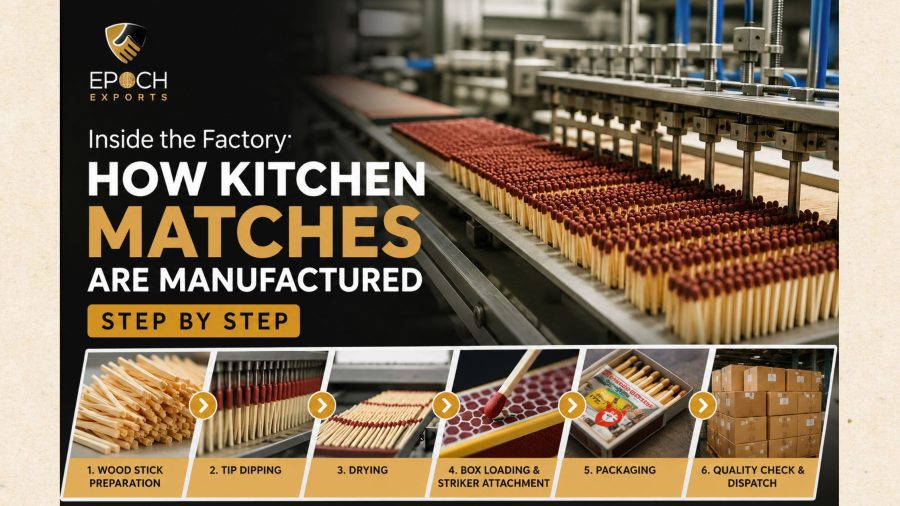
Inside the Factory: How Kitchen Matches Are Manufactured Step by Step
Introduction
Kitchen matches manufacturers play a vital role in supplying reliable ignition products for households, restaurants, hotels, and commercial kitchens worldwide. While kitchen matches may appear simple, their manufacturing process involves multiple stages of precision engineering, quality control, and safety management to ensure consistent performance and user safety.
For importers, distributors, wholesalers, and bulk buyers, understanding how kitchen matches are produced provides valuable insight into product quality, supplier capabilities, and export reliability.
As a leading kitchen safety matches manufacturer, Epoch Exports follows a structured production process that begins with raw material selection and continues through manufacturing, testing, packaging, and international shipment.
Step 1 – Selection of Raw Materials by Kitchen Matches Manufacturers:
The quality of a kitchen match begins with the careful selection of raw materials. Reputable kitchen matches manufacturers prioritize high-grade materials to ensure durability and reliable ignition.
i) Softwood and Splints
Softwood is commonly chosen for manufacturing match splints due to its lightweight structure and uniform burning characteristics. The wood is sourced and processed into thin strips suitable for matchstick production.
ii) Chemical Ingredients
Several carefully formulated chemicals are used to create the match head and striker surface, including:
- Potassium chlorate
- Sulphur
- Glass powder
- Binding agents
- Coloring compounds
- Red phosphorus (used on the striking surface)
Each ingredient serves a specific purpose in ensuring controlled ignition and safe usage.
iii) Matchbox Materials
Matchboxes are typically manufactured using durable duplex board materials that provide structural strength while allowing attractive printing and branding options for export customers.
Step 2 – Matchstick Splint Preparation:
Once raw materials are selected, the wooden splints undergo a series of preparation processes.
i) Cutting and Sizing
Large wooden sheets are precisely cut into thin splints of uniform dimensions. Consistent sizing is essential because it directly impacts burning performance and packaging efficiency.
ii) Drying Process
The freshly prepared splints contain natural moisture that must be removed. Controlled drying systems reduce moisture levels to achieve the desired stability and prevent warping.
iii) Surface Treatment
After drying, the splints may be treated with protective coatings such as wax or paraffin. This treatment enhances ignition performance and ensures smoother burning characteristics.
At this stage, manufacturers carefully inspect splints for dimensional accuracy and structural integrity before moving to chemical coating.
Step 3 – Chemical Dipping and Match Head Formation:
This is one of the most critical stages in the manufacturing process.
i) Preparing the Match Head
The match head compound is created using a carefully balanced formulation designed to provide safe and reliable ignition. The composition must deliver optimal performance while maintaining safety during storage and transportation.
ii) Dipping Process
The prepared splints are passed through automated dipping systems where their tips are coated with the match head compound. Modern production facilities ensure:
- Uniform coating thickness
- Consistent match head size
- Reduced material wastage
- High-volume production efficiency
iii) Safety Measures During Chemical Handling
As a responsible kitchen safety matches manufacturer, Epoch Exports follows strict handling procedures when working with chemical compounds.
Dedicated production zones, trained personnel, and controlled environments contribute to safe operations. The coated matchsticks are then transferred for curing and drying.
Step 4 – Drying and Curing Process Used by Kitchen Matchstick Exporters:
Following chemical coating, the matches require controlled drying to stabilize the match heads.
i) Controlled Drying Chambers
Advanced drying chambers provide regulated temperature and airflow conditions that help the chemical coating cure properly.
ii) Moisture Management
Proper moisture control is critical because excessive moisture can affect ignition performance, while insufficient drying may weaken the match head structure.
iii) Strength and Ignition Testing
Before moving to packaging operations, manufacturers conduct preliminary evaluations, including:
- Head adhesion testing
- Burn consistency testing
- Ignition reliability assessment
Leading kitchen matchstick exporters understand that proper curing directly impacts product performance in international markets with varying climate conditions.

Step 5 – Matchbox Manufacturing and Friction Surface Application:
The next stage focuses on producing the matchbox and striker surface.
i) Box Fabrication
Duplex board sheets are cut, folded, and assembled into inner and outer box structures. Precision manufacturing ensures smooth opening and secure storage.
ii) Printing and Branding
Custom branding is particularly important for importers and distributors. Matchboxes can be printed with:
- Company logos
- Product information
- Regulatory markings
- Multilingual labels
- Private-label branding
iii) Application of Striking Surface
The friction surface is applied to the side of the matchbox using a specialized coating that typically contains red phosphorus and other controlled ingredients.
This striking surface works together with the match head to create safe ignition while reducing accidental combustion risks.
Step 6 – Quality Inspection by Kitchen Matches Manufacturers in India:
Quality control is an essential component of production. Leading kitchen matches manufacturers in India implement multiple inspection stages to verify product performance before shipment.
i) Match Head Strength Test
Manufacturers evaluate the adhesion strength of the match head to ensure it remains intact during transportation and handling.
ii) Ignition Performance Test
Samples are tested for:
- Ease of striking
- Consistent ignition
- Flame stability
- Burn duration
iii) Packaging Quality Check
Packaging inspections verify:
- Box dimensions
- Label accuracy
- Carton strength
- Product count consistency
Reliable kitchen matches manufacturers in India understand that comprehensive testing reduces customer complaints and strengthens long-term business relationships.
Step 7 – Packaging, Bulk Packing, and Export Preparation:
After passing all quality inspections, the finished products move to packaging and export preparation.
i) Retail Packaging
Kitchen matches are carefully packed in durable, retail-ready boxes that ensure convenient handling, safe storage, and easy everyday use.
ii) Carton Packing for Bulk Orders
For wholesalers and distributors, individual boxes are arranged into export-grade cartons that provide protection during storage and transit.
iii) Documentation for International Exports
Professional kitchen matchstick exporters in India prepare the necessary documentation required for smooth international trade, including:
- Commercial invoices
- Packing lists
- Shipping documentation
- Export compliance records
Efficient export procedures help buyers receive products on schedule and with minimal customs-related complications.
Kitchen Matches Manufacturing Process at a Glance:
| Manufacturing Stage | Purpose | Quality Parameter |
| Raw Material Selection | Ensure product consistency | Material inspection |
| Splint Preparation | Create uniform matchsticks | Dimensional accuracy |
| Chemical Coating | Enable safe ignition | Head adhesion |
| Drying & Curing | Stabilize match heads | Moisture testing |
| Box Manufacturing | Secure storage | Structural strength |
| Quality Testing | Verify reliability | Ignition performance |
| Export Packaging | Protect shipment | Carton integrity |
Typical Specifications of Export-Quality Matches:
| Feature | Typical Specification |
| Match Length | 40–50 mm |
| Splint Material | Softwood |
| Head Composition | Safety Match Chemicals |
| Ignition Quality | Smooth and Consistent |
| Packaging Type | Retail and Bulk Export |
| Application | Household and Commercial Kitchens |
Why Epoch Exports is a Trusted Kitchen Safety Matches Manufacturer?
Epoch Exports has established itself as a dependable kitchen safety matches manufacturer serving global buyers across multiple markets. The company combines modern production methods with stringent quality controls to deliver products that meet international expectations.
As one of the recognized kitchen matches manufacturers in India, Epoch Exports focuses on:
- Consistent manufacturing quality
- Export-oriented production standards
- Customized packaging solutions
- Private-label support
- Timely shipment execution
- Large-volume order fulfillment
Recognized among leading kitchen matches manufacturers in India, Epoch Exports caters to the evolving needs of importers, distributors, and wholesale buyers across international markets. As one of the dependable kitchen matchstick exporters in India, the company maintains rigorous quality checks at every stage of manufacturing to ensure product consistency.
Being a trusted kitchen safety matches manufacturer and safety Matches Manufacturer, Epoch Exports is committed to supplying high-quality matches that deliver reliable performance, improved safety, and export-grade packaging standards. This commitment to excellence helps buyers source kitchen matches with confidence from a trusted export partner.
Final Words
From raw material selection and splint preparation to chemical coating, quality testing, and international shipment, every stage contributes to product performance and safety. By partnering with Epoch Exports, one of the experienced kitchen matches manufacturers, importers and distributors can secure consistent products, reliable deliveries, and long-term sourcing confidence in competitive global markets.
Stay ahead of market demand with premium kitchen matches from Epoch Exports, trusted by importers, wholesalers, and distributors for reliable international supply.
FAQs:
1. What materials are used to manufacture kitchen matches?
Kitchen matches are typically made from softwood splints, safety match chemicals, wax coatings, duplex board packaging, and specially formulated striker materials.
2. How do kitchen matches manufacturers ensure safety?
Manufacturers conduct rigorous testing, controlled chemical handling, moisture management, ignition performance checks, and packaging inspections throughout production.
3. Why are kitchen matches manufacturers in India preferred by global buyers?
Indian manufacturers offer competitive pricing, large-scale production capabilities, consistent quality standards, and extensive export experience.
4. What quality tests are performed before export?
Manufacturers perform ignition tests, burn consistency evaluations, match h